
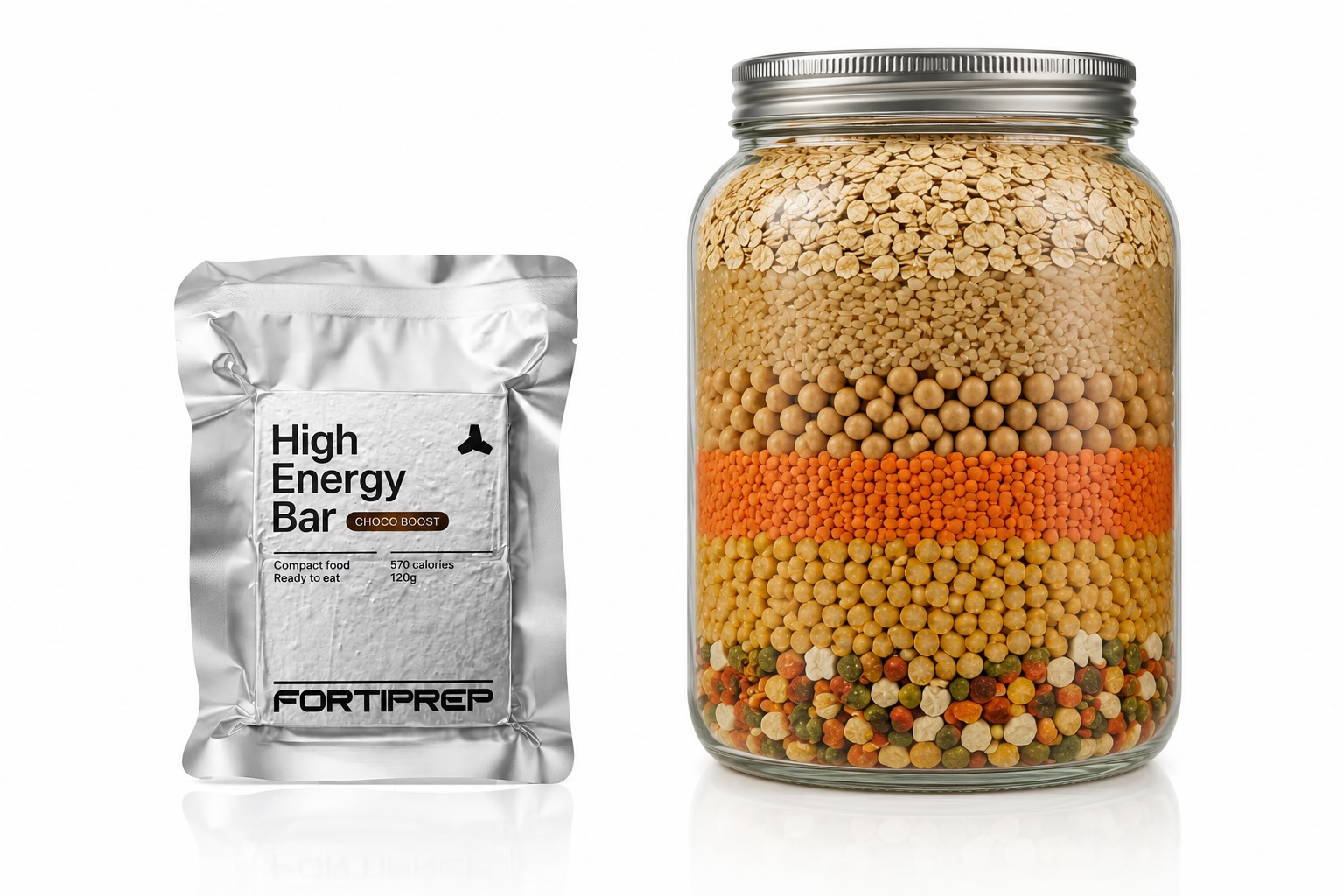
When people think about emergency food storage, the first thing that often comes to mind is canned food. Beans, meat, soups, vegetables, ready meals — stacked in a basement or pantry for “just in case.” Canned food absolutely has its place in preparedness. It is familiar, widely available and relatively durable. But modern emergency preparedness is evolving.
Today, many emergency food systems are specifically designed not only to provide calories, but to deliver:
- balanced nutrition,
- compact energy density,
- long-term stability,
- and practical functionality during real crisis situations.
This is where fortified emergency food differs fundamentally from traditional canned food.
What Is Fortified Emergency Food?
Fortified emergency food is specifically designed for preparedness and crisis situations.
Unlike ordinary shelf food, it is intentionally optimized for:
- long storage life,
- nutritional density,
- portability,
- efficient calorie delivery,
- and minimal preparation requirements.
Many fortified products also contain added:
- vitamins,
- minerals,
- proteins,
- or balanced macronutrient ratios.
The goal is not simply to “fill the stomach,” but to support physical and mental performance during stressful conditions.
Traditional Canned Food: Strengths and Limitations
Canned food remains one of the most practical forms of food preservation ever developed.
It offers several advantages:
- long shelf life,
- protection against contamination,
- ready-to-eat convenience,
- and wide availability.
However, traditional canned food was not originally designed specifically for emergency preparedness.
Most canned products were created for:
- convenience,
- taste,
- or short-to-medium-term household storage.
This difference becomes important during prolonged emergency situations.
The Problem with Weight and Volume
One of the biggest limitations of canned food is water content.
Many canned foods contain:
- sixty to eighty percent water.
That means:
- higher weight,
- larger storage volume,
- and lower calorie density.
For example, transporting or storing enough canned food for several weeks quickly becomes heavy and inefficient.
Fortified emergency foods are often designed to minimize unnecessary water weight while maximizing usable calories.
This makes them:
- easier to transport,
- easier to store,
- and more efficient during real disruptions.
Nutritional Density Matters
During a crisis, nutrition becomes more important — not less. Stress, cold temperatures, physical labor and lack of sleep all increase nutritional demands. Traditional canned foods vary enormously in nutritional quality.
Some products contain:
- excessive salt,
- low protein,
- high sugar,
- poor micronutrient balance,
- or limited caloric value.
Fortified emergency foods are often engineered specifically to provide:
- stable energy,
- balanced macronutrients,
- added vitamins,
- and functional nutrition.
This becomes especially important during longer disruptions.
Shelf Life: Not All Long Shelf-Life Foods Are Equal
Many canned foods last several years. But fortified emergency foods are often designed for significantly longer storage periods under proper conditions.
This is achieved through:
- lower moisture content,
- oxygen-controlled packaging,
- specialized barrier materials,
- and optimized preservation methods.
Some modern preparedness products are designed for storage periods measured not merely in years — but in decades.
Portability and Practical Use
In real emergencies, mobility may become important.
A family may need to:
- relocate,
- evacuate,
- transport supplies,
- or operate without infrastructure support.
Large quantities of canned food become difficult to move quickly because of:
- weight,
- metal packaging,
- and storage inefficiency.
Fortified emergency food systems are often built with portability in mind.
This includes:
- compact packaging,
- resealable pouches,
- lightweight storage,
- and stackable systems.
Water and Preparation Requirements
One criticism sometimes directed at emergency foods is that some products require water or preparation. This is true for certain freeze-dried meals.
However, many modern emergency food systems are designed to be:
- ready-to-eat,
- minimal-preparation,
- or usable even during power outages.
Meanwhile, canned foods may also present practical challenges:
- heavy waste,
- limited portability,
- difficult storage after opening,
- and lower calorie efficiency.
Why Fortification Matters
A major difference between ordinary shelf food and preparedness-oriented food is intentional fortification.
Fortified emergency foods may include additional:
- vitamins,
- protein,
- electrolytes,
- minerals,
- or optimized energy ratios.
Why?
Because in prolonged stressful situations, nutritional deficiencies appear surprisingly quickly. People often focus only on calories during preparedness planning.
But functioning during a crisis requires much more:
- mental clarity,
- immune resilience,
- muscle recovery,
- and sustained energy.
Calories alone are not enough.
Psychological Factors Matter Too
Preparedness is not purely technical. Food strongly affects morale. During stressful situations, psychologically comforting food becomes surprisingly important.
Modern emergency food systems increasingly recognize this by focusing not only on survival, but also on:
- taste,
- variety,
- texture,
- and overall eating experience.
This is another area where preparedness-focused food has evolved beyond the old stereotype of “survival rations.”
So Which One Is Better?
The answer is: both have value — but for different purposes.
Traditional canned food is excellent for:
- short-term disruptions,
- daily pantry rotation,
- familiar comfort foods,
- and immediate convenience.
Fortified emergency food is designed for:
- longer-term preparedness,
- efficient storage,
- nutritional resilience,
- portability,
- and structured emergency planning.
The most resilient preparedness strategy often combines both approaches.
Modern Preparedness Is About Functionality
Preparedness is no longer simply about stockpiling random food.
Modern emergency planning focuses on:
- efficiency,
- nutritional quality,
- storage stability,
- mobility,
- and practical real-world usability.
Fortified emergency food represents the next evolution of preparedness nutrition:
not merely surviving a crisis — but maintaining capability during one.
And in an increasingly uncertain world, that difference matters more every year.

Leave a Reply